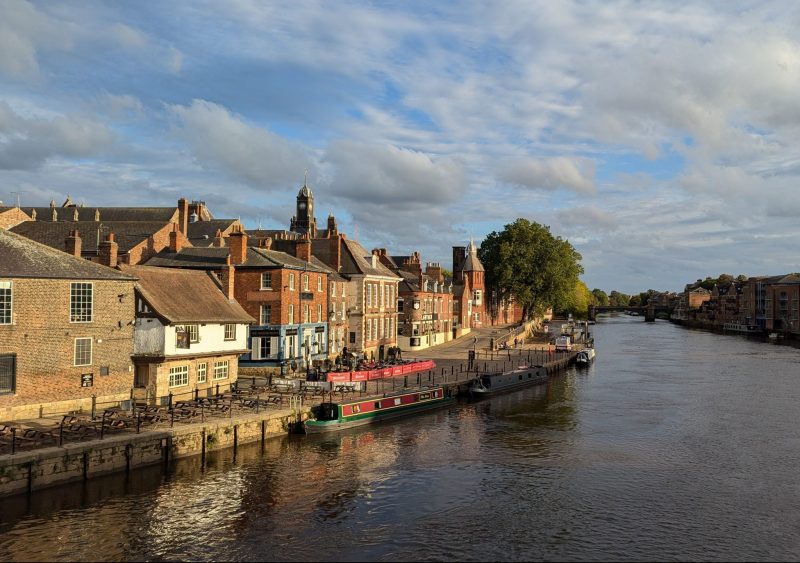
York’s history is often told through its walls and great buildings, the Roman fortress footprint, the Viking street grid, the medieval Minster, and the Georgian terraces. Another history runs alongside that one, quieter, but easier to recognise how people spent their free time.
Across two millennia, residents and visitors found ways to socialise, play, and decompress. Some of those rituals were formal, religious festivals or civic celebrations. Others were casual and repetitive: a drink after work, a stroll by the river, a game at a table.
The venues and customs changed with each era, but the basic pattern stayed intact. When York’s working day ended, the city shifted into its second life.
Roman York: Civic Life Beyond the Fortress
York began as Eboracum, a Roman legionary fortress founded in the first century. A military base attracted traders, craftspeople, families, and the infrastructure of a proper town.
Leisure in Roman Britain often centred on communal spaces. Bathing was both a matter of hygiene and social theatre, a routine that brought strangers into conversation and turned a visit into an event. Taverns and eating houses served a similar role for those who preferred noisier rooms.
Games sat comfortably inside that world. Archaeology across Roman sites has shown the popularity of dice and board games, and York’s garrisoned population would have had long stretches of waiting between campaigns and duties. In a frontier city, amusement did not need to be elaborate to be shared. However, for those at the heart of the empire, leisure reached its peak with the gladiatorial legacy of the Colosseum, where the spectacle was as grand as the architecture itself.
Jorvik: Trade, Feasting, and Play Indoors
By the ninth and tenth centuries, York was a Viking-age trading centre. The city’s social life tilted toward indoor gatherings, especially in the colder months, when communal rooms doubled as dining halls, workshops, and meeting places.
Feasts were one of the era’s most visible entertainments. They mixed food, storytelling, and status, reinforcing ties across households and trade networks. A feast was not an escape from politics; it was politics in another format.
Board games were part of that domestic culture. Strategy games such as hnefatafl have become shorthand for Viking leisure, but the point is broader. Competitive play was portable, social, and suited to a city where people lived close together.
Medieval York: The Streets as a Social Venue
In medieval York, the calendar shaped recreation. Religious festivals, saints’ days, and seasonal fairs created sanctioned breaks from routine, drawing crowds into the streets and markets.
Guild culture also mattered. Trade guilds provided professional control, but they also organised dinners, processions, and mutual support. Belonging to a guild offered a ready-made social world, with obligations that often ended in shared food and drink.
Public performance became one of York’s signatures. The city’s mystery play tradition, produced by guilds, turned biblical stories into civic spectacle. It was a theatre without a dedicated theatre building, using wagons, streets, and the attention of a packed audience.
Alongside these organised events, the everyday spaces carried their own leisure. Alehouses, river paths, churchyards, and market corners offered informal gathering points. Not every form of relaxation needs a programme.
Small games of chance sat alongside the public spectacle. Dice, cards, and informal wagers moved through taverns and private rooms, often as social glue rather than a formal pastime. The modern digital version follows that line, including the new casino sites on offer that mirror older habits in a newer setting.
Eighteenth-Century York: Leisure Becomes Scheduled
By the eighteenth century, York’s social life had clearer timetables and dedicated venues. Coffeehouses and clubs supported conversation and business at a slower pace than the market. Promenading became an activity in itself, a public performance of manners and belonging.
Theatre consolidated as a commercial night out. York Theatre Royal dates to 1744, and its presence signalled an audience willing to pay for scripted entertainment in a fixed space rather than relying on occasional touring shows.
Sporting leisure expanded too. York’s racing history includes early civic support and documented meetings in the early eighteenth century. The race meeting was a social calendar anchor as much as a sporting event, bringing together different classes in shared excitement, and not always shared comfort.
From Victorian Parlours to the Screen in Your Pocket
Industrial-era York widened access to recreation, even as working life remained demanding. Public parks and organised excursions offered a respectable version of relaxation. Pubs and music halls supplied the louder alternative.
Chance and competition remained constant. Card games and small-stakes betting circulated through private rooms and public houses, echoing older habits of dice and wagers. In the contemporary digital landscape, the same appetite appears in different clothing and sits alongside other forms of entertainment rather than replacing them.
In the twentieth and twenty-first centuries, York’s leisure economy became entangled with tourism. Cinemas, festivals, football culture, and the city’s pubs and restaurants all feed into a mixed social scene. Locals still use familiar routines, walks on the walls, evenings in small pubs, and meeting friends near the river, but they now do it in a city that also hosts a constant flow of visitors.
Final Thoughts
The details shift from era to era, but the needs do not. People looked for warmth, company, distraction, and stories, and they built social routines around what the city offered at the time.
York’s long history makes those layers easier to spot. A Roman-style communal bath and a modern café serve different products, but both create a setting where strangers can share space without formal invitation. A medieval festival crowd and a contemporary festival crowd move for various reasons, but the noise and release are recognisable.
In York, leisure has never been separate from the city’s identity. It has been part of how residents have endured work, celebrated change, and marked time.