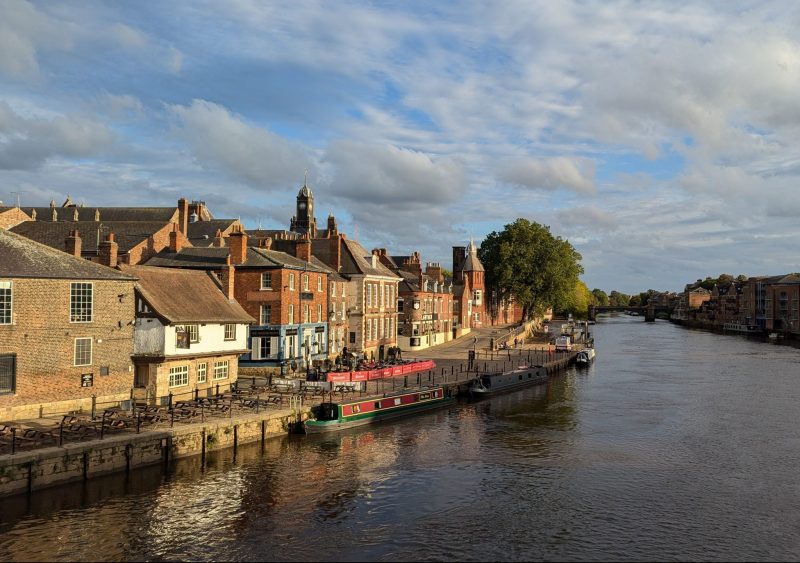
York does something to people. You come for a weekend, walk the walls at dusk, end up in a snickelway you didn’t mean to find, and by Sunday you’re looking in estate agents’ windows.
The city has more genuinely old housing stock than almost anywhere in England, and living in it is a real pleasure. It also comes with a set of considerations that don’t apply to a 1990s semi. None of them are reasons not to buy. All of them are reasons to look properly first.
Listed, or in a conservation area — and they’re not the same thing
York has a large number of listed buildings and several conservation areas, and the two work differently.
Listing protects the building itself, inside and out. Listed building consent is needed for alterations that affect its character, and that can extend to things people don’t expect — internal doors, fireplaces, staircases, sometimes the original window frames. Work done without consent is an offence, and crucially it doesn’t expire. If a previous owner replaced the windows in 2009 without permission, that becomes your problem when you come to sell.
Conservation areas protect the character of the wider street or district rather than individual buildings. Rules are lighter but real, particularly around windows, roofing materials, satellite dishes and trees.
Ask the seller directly whether any work has been done, when, and whether consent was obtained. Then have your solicitor confirm it rather than taking the answer at face value. It’s a routine check and it saves a great deal of grief later.
Flooding is a genuine consideration, and a specific one
York sits where the Ouse meets the Foss, and parts of the city flood. This isn’t a secret and it isn’t a reason to avoid the place — but risk varies enormously from street to street, and sometimes from one end of a street to the other.
What matters practically is insurance. Ask the seller whether the property has flooded, whether it’s covered under the Flood Re scheme, and what they currently pay. A property that’s hard to insure is a property that’s harder to sell later, because your eventual buyer will run into the same difficulty and their lender may take a view on it.
Check the official flood risk information for the actual address rather than the postcode. The granularity matters here more than almost anywhere.
The things that make old buildings old
A survey on a period property is not optional, and a basic valuation isn’t a survey. Pay for the full one.
Common findings in York’s older stock include damp in solid walls that were never designed to be sealed, historic timber treatment, roof spread on older structures, and cellars that are dry in July and less so in January. Most of these are manageable and many are simply how buildings of that age behave. What you’re paying the surveyor for is the difference between “normal for the period” and “expensive.”
Be particularly careful with anything that’s been modernised enthusiastically. Cement render and impermeable paint on a building that needs to breathe cause more problems than they solve, and putting that right costs more than never having done it.
Think about the exit while you’re buying
This sounds unromantic when you’ve just fallen for a Georgian townhouse, but it’s the single most useful thing you can do.
The features that make a period property special are the same ones that narrow the buyer pool later. Listed status, flood history, no parking, a cellar, non-standard construction, a shared access — each is fine, and each reduces the number of people who can or will buy it from you. Some lenders decline particular property types outright, which removes a slice of the market before you even reach viewings.
That’s worth knowing in advance rather than discovering it under time pressure. If you ever need to move quickly, a property with any of those characteristics can sit for a long time on the open market. Specialist buyers exist for exactly this reason — firms that buy harder-to-sell properties including listed, flood-affected and non-standard construction homes, generally at below open-market value in exchange for speed and certainty.
Most people won’t need that. But knowing the option is there changes how it feels to own something unusual, and it’s a better position than finding out at the point you’re desperate.
The practical checklist
Before you commit, get answers on:
- Listed status and conservation area, and consent for any past work
- Flood history, current insurance cost, and Flood Re eligibility
- Full building survey, not a valuation
- Parking, and whether any permit scheme applies
- Access arrangements if the property shares a lane, yard or passage
- Any restrictive covenants, which are common on older York properties
Worth it
None of this should put you off. York’s older houses are a genuine pleasure to live in, and people who buy them tend to stay.
Just go in with your eyes open, spend the money on the survey, and ask the awkward questions before you’re emotionally committed rather than after. The building has stood for two or three hundred years. It’ll wait another fortnight while you check.